Sunday, July 14, 2013

Consensus part 2 - The Empirical Evidence

My previous "consensus" post had been sitting there for days, on the way to joining the ranks of abandoned projects.  However, I came across this recent post from SkepticalScience.com that rekindled my interest in seeing it through.

Now that I've posted that - I should support it with the "empirical evidence, which those fine volunteers at SkepticalScience.com have done such a good job of compiling.  


~ ~ ~ ~ ~ ~ ~ ~ ~ ~ ~ ~ ~ ~ ~ ~ 


Empirical evidence that humans are causing global warming (via Skeptical Science)
Posted on 9 July 2013 by gpwayne This post is a new 'basic' level rebuttal of the myth: "There is no actual empirical evidence that carbon dioxide emissions are causing global warming." What the Science Says: Less energy is escaping to space. Carbon…

Consensus on manmade global warming? What consensus?

The games people play are incredible.  For months now Mr. Anthony WattsUpWithThat and friends have been waging a slur-campaign against the findings of a recent Skeptical Science project which has been accepted for publication.  The Consensus Project which reviewed 12,000 scientific papers found that 97% of the papers reviewed agreed on the point that current global warming is clearly human caused.

Without getting into the details, Anthony's objections, even if valid and accepted, would reject less than 1% of that 97% consensus.  OK so what if it's only 96% of the papers?  And on such thin threads do scared, angry politicized citizens hang.

I'm inspired to post this list because of the countless and hopeless dog-chasing-tail dialogues I see going on throughout the blogosphere.  

There is simply no getting around the down to earth facts: 

A) Atmospheric Greenhouse Gases are for real.
B) We are adding huge amounts, on top of natural levels.
C) This will/is retaining more heat within our biosphere.
D) More heat within our biosphere and global climate system will energize the components of that system.
E) More CO2 will increase atmospheric moisture.
D) More heat and moisture and energy will create increasingly rough weather.
E) Our complex society is dependent on moderate weather.

What are we going to do about it - just watch it play out?

~ ~ ~ ~ ~ ~ ~ ~ ~ ~ ~ ~ ~ ~ ~ ~ ~ 
The following is copied from
NASA - Global Climate Change - Vital Signs of the Planet

~ ~ ~ ~ ~ ~ ~ ~ ~ ~ ~ ~ ~ ~ ~ ~ ~ 


Consensus: 
97% of climate scientists agree percent of climate scientists agree that climate-warming trends over the past century are very likely due to human activities,1 and most of the leading scientific organizations worldwide have issued public statements endorsing this position. The following is a partial list of these organizations, along with links to their published statements and a selection of related resources.


Temperature data from four international science institutions. All show rapid warming in the past few decades and that the last decade has been the warmest on record.


AMERICAN SCIENTIFIC SOCIETIES

Statement on climate change from 18 scientific associations
"Observations throughout the world make it clear that climate change is occurring, and rigorous scientific research demonstrates that the greenhouse gases emitted by human activities are the primary driver." (2009)


American Association for the Advancement of Science
"The scientific evidence is clear: global climate change caused by human activities is occurring now, and it is a growing threat to society." (2006)


American Chemical Society
"Comprehensive scientific assessments of our current and potential future climates clearly indicate that climate change is real, largely attributable to emissions from human activities, and potentially a very serious problem." (2004)


American Geophysical Union
"The Earth's climate is now clearly out of balance and is warming. Many components of the climate system — including the temperatures of the atmosphere, land and ocean, the extent of sea ice and mountain glaciers, the sea level, the distribution of precipitation, and the length of seasons — are now changing at rates and in patterns that are not natural and are best explained by the increased atmospheric abundances of greenhouse gases and aerosols generated by human activity during the 20th century." (Adopted 2003, revised and reaffirmed 2007)


American Medical Association
"Our AMA ... supports the findings of the Intergovernmental Panel on Climate Change’s fourth assessment report and concurs with the scientific consensus that the Earth is undergoing adverse global climate change and that anthropogenic contributions are significant." (2013)


American Meteorological Society
"It is clear from extensive scientific evidence that the dominant cause of the rapid change in climate of the past half century is human-induced increases in the amount of atmospheric greenhouse gases, including carbon dioxide (CO2), chlorofluorocarbons, methane, and nitrous oxide." (2012)


American Physical Society
"The evidence is incontrovertible: Global warming is occurring. If no mitigating actions are taken, significant disruptions in the Earth’s physical and ecological systems, social systems, security and human health are likely to occur. We must reduce emissions of greenhouse gases beginning now." (2007)

The Geological Society of America
"The Geological Society of America (GSA) concurs with assessments by the National Academies of Science (2005), the National Research Council (2006), and the Intergovernmental Panel on Climate Change (IPCC, 2007) that global climate has warmed and that human activities (mainly greenhouse‐gas emissions) account for most of the warming since the middle 1900s." (2006; revised 2010)

SCIENCE ACADEMIES

International academies: Joint statement
"Climate change is real. There will always be uncertainty in understanding a system as complex as the world’s climate. However there is now strong evidence that significant global warming is occurring. The evidence comes from direct measurements of rising surface air temperatures and subsurface ocean temperatures and from phenomena such as increases in average global sea levels, retreating glaciers, and changes to many physical and biological systems. It is likely that most of the warming in recent decades can be attributed to human activities (IPCC 2001)." (2005, 11 international science academies)


U.S. National Academy of Sciences
"The scientific understanding of climate change is now sufficiently clear to justify taking steps to reduce the amount of greenhouse gases in the atmosphere." (2005)


U.S. GOVERNMENT AGENCIES


U.S. Global Change Research Program
"The global warming of the past 50 years is due primarily to human-induced increases in heat-trapping gases. Human 'fingerprints' also have been identified in many other aspects of the climate system, including changes in ocean heat content, precipitation, atmospheric moisture, and Arctic sea ice." (2009, 13 U.S. government departments and agencies)


INTERGOVERNMENTAL BODIES


Intergovernmental Panel on Climate Change
“Warming of the climate system is unequivocal, as is now evident from observations of increases in global average air and ocean temperatures, widespread melting of snow and ice, and rising global average sea level.”13

“Most of the observed increase in global average temperatures since the mid-20th century is very likely* due to the observed increase in anthropogenic greenhouse gas concentrations.”

 *IPCC defines ‘very likely’ as greater than 90 percent probability of occurrence.


OTHER RESOURCES
List of worldwide scientific organizations
The following page lists the nearly 200 worldwide scientific organizations that hold the position that climate change has been caused by human action.
http://opr.ca.gov/s_listoforganizations.php

U.S. agencies
The following page contains information on what federal agencies are doing to adapt to climate change.
http://www.c2es.org/docUploads/federal-agencies-adaptation.pdf

References

1
W. R. L. Anderegg, “Expert Credibility in Climate Change,” Proceedings of the National Academy of Sciences Vol. 107 No. 27, 12107-12109 (21 June 2010); DOI: 10.1073/pnas.1003187107.


P. T. Doran and; M. K. Zimmerman, "Examining the Scientific Consensus on Climate Change," Eos Transactions American Geophysical Union Vol. 90 Issue 3 (2009), 22; DOI: 10.1029/2009EO030002.


N. Oreskes, “Beyond the Ivory Tower: The Scientific Consensus on Climate Change,” Science Vol. 306 no. 5702, p. 1686 (3 December 2004); DOI: 10.1126/science.1103618.


Friday, July 12, 2013

Extreme Ice Survey - observing our planet's cryosphere

Eyewitness accounts of the state of our planet's cryosphere don't come easy or cheap.  

Making science accessible to the public is also a challenge that needs the active help of citizens.  

Please become familiar with this effort - perhaps you can help James Balog and his team.

~ ~ ~ ~ ~ ~ ~ ~ ~ ~ ~ ~ ~ ~ ~ ~ ~ 


http://extremeicesurvey.org/about-eis/

Founded in 2007 by James Balog, the Extreme Ice Survey (EIS) is an innovative, long-term photography project that merges art and science to give a “visual voice” to the planet’s changing ecosystems. 

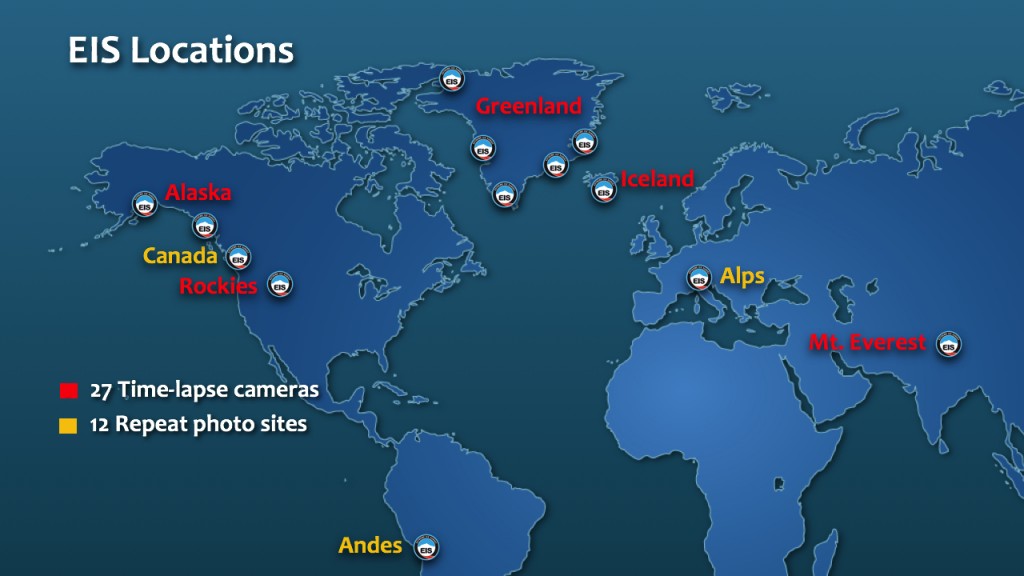
One aspect of EIS is an extensive portfolio of single-frame photos celebrating the beauty–the art and architecture–of ice. The other aspect of EIS is time-lapse photography; currently, 28 cameras are deployed at 13 glaciers in Greenland, Iceland, the Nepalese Himalaya, Alaska and the Rocky Mountains of the U.S. (Plans to expand the EIS camera network into South America and Antarctica are currently underway.) 


Dark Snow Project - July 2013

With tightening budgets, increasing numbers of important projects are being short-funded or defunded altogether.  Here's an example of a young scientist, Jason Box taking matters into his own hands and with the help of some friends - reaching out to regular citizens - to help support his scientific expedition to Greenland.

It's been about a year since Jason began his odyssey and it's about time I posted on it.

~ ~ ~ ~ ~ ~ ~ ~ ~ ~ ~ ~ ~ ~ ~ 

Dark Snow Project


For an introduction:
Live From New York: It's the Dark Snow Project

Monday, June 24, 2013

Global Warming is about more than cherry picked surface temperatures!

{edited 6/12/2013 noon}

Global warming is about a Global Heat Distribution Engine that is being super-charged with more heat and energy and moisture. { I've linked to some interesting back up information in the next two paragraphs, check it out.}

This reality is reflected in the Arctic where the millennia old ice cap is continuing it's death spiral.  Which in turn is disrupting atmospheric circulation patterns and our jet stream  And in the Antarctic where some areas are gaining snow due to increased atmospheric moisture (from a warmer ocean) causing never before observed snow fall rates, while the millennia old Ice Sheets are melting at an alarming rate.

The warming is also reflected in the drum beat of extreme weather events.  Just in the past month we have witnessed unprecedented floods in Calgary and Europe and Asia.  A 2.6 mile wide tornado at El Reno, Oklahoma.  
This is what global warming looks like.

But, we still find folks like James Taylor at Forbes, Anthony Watts at WUWT (and too many others to count) hollering at the top of their lungs there's no warming.  Yes there is!  
Stop pretending our planet isn't an actual entity that we depend on and that regular people need to start to understand.

We have a real situation that needs pragmatic honesty rather an entrenched political warriors dedicated to policy rather than learning about this planet we depend on.

For those with a sincere curiosity and desire to learn about our planet and what global warming actually means here's a start with some videos.  

First, a recent lecture about the state of climatological understanding by Professor Howard Spero.  It includes a good question and answer session.  Following by a short NASA video about our cryosphere based on satellite images.

Then a link to a tour de force of our planet's "global heat distribution engine" using the latest satellite data and state of the art computer graphics, it's a hour and a half long, but worth every minute... if you want to get a sense of what climatologists are talking about.

Enjoy !
~ ~ ~ ~ ~ ~ ~ ~ ~ ~ ~ ~ ~ ~ ~ ~ ~ ~ ~ ~ ~


Our Changing Seas

UCTVSeminars  |  Published on Jan 8, 2013  |  1:40:35

(Visit: http://seminars.uctv.tv/) 
The study of climate change through Earth history has produced a wealth of information on the operation of the ocean-atmosphere system during climate transitions as well as the feedbacks that impact the magnitude and rate of climate change on the planet.  
Although the understanding of the science of climate is built on a firm foundation, much confusion exists regarding the potential and rate of change in the modern world. In this talk, Dr. Howard Spero will explore the basic science of the Earth's climate system and examine the natural cycles of climate change in Earth history that have been discovered through the study of glacial ice sheets and deep ocean cores.  
Utilizing the lessons learned these studies, Dr. Spero will attempt to demystify the realities of phenomena such as ocean (and Lake Tahoe) acidification and the potential for a warmer Earth in the not too distant future. [Show ID: 24674]
~ ~ ~ ~ ~ ~ ~ ~ ~ ~ ~ ~ ~ ~ ~ ~ ~ ~ ~ ~ ~


Tour of the Cryosphere
http://www.youtube.com/watch?v=JVJttlGP10o
spaceship990  |  Apr 27, 2013  |  5:12

The cryosphere consists of those parts of the Earth's surface where water is found in solid form, including areas of snow, sea ice, glaciers, permafrost, ice sheets, and icebergs. In these regions, surface temperatures remain below freezing for a portion of each year. Since ice and snow exist relatively close to their melting point, they frequently change from solid to liquid and back again due to fluctuations in surface temperature. 
Although direct measurements of the cryosphere can be difficult to obtain due to the remote locations of many of these areas, using satellite observations scientists monitor changes in the global and regional climate by observing how regions of the Earth's cryosphere shrink and expand. 
Video credit: NASA/Goddard Space Flight Center Scientific Visualization Studio The Blue Marble Next Generation data is courtesy of Reto Stockli (NASA/GSFC) and NASA's Earth Observatory. Historic calving front locations courtesy of Anker Weidick and Ole Bennike, Geological Survey of Denmark and Greenland
~ ~ ~ ~ ~ ~ ~ ~ ~ ~ ~ ~ ~ ~ ~ ~ ~ ~ ~ ~ ~

For something even more informative here's a great hour and half tour that describes this entity I like calling our Global Heat Distribution Engine:

Earth From Space (HD)

Published on Aug 20, 2012
Earth Playlist- http://www.youtube.com/playlist?list=...

Venture on an epic quest to discover the invisible forces and occurrences that sustain life on this planet and - for the first time - see these processes in action in EARTH FROM SPACE. This sweeping two-hour special reveals the Earth's deepest mysteries, captured in breath-taking detail, and raises profound questions and challenges the old assumptions of how it all works. Using the latest CGI technology, and joining NASA and the world's foremost Earth scientists, EARTH FROM SPACE transforms raw satellite data into a visible spectrum, offering viewers authentic, high-definition moving images that vividly illustrate these processes at work.

In consultation with more than 220 scientific experts from 18 international Earth sciences research agencies and academic institutions, highlights from EARTH FROM SPACE reveal:

A hurricane - observed from the inside - is an intricately-organized structure. See how it bonds water to atmosphere, and releases heat into space, cooling parts of the Atlantic by 4C.

The Amazon produces 20% of the Earth's fresh water. Where does all this water go and what is its effect on air circulating around the planet and life across the globe?

See how solar storms puncturing great holes in the magnetic field raise new questions about the disruptive effect they have on life on a microscopic level.

Data shows that the top three meters of the ocean stores more heat than the entire atmosphere - overturning the long-held assumptions about how the ocean controls weather and climate.

Saturday, June 22, 2013

World Bank considers the impact of our warming world


The World Bank has released a new climate change report titled: "Turn Down the Heat: Climate Extremes, Regional Impacts, and the Case for Resilience."  It is the second of a series of in depth studies focusing on the likely impacts of our warming world.  And though it focuses on Africa and Asia it's reporting on the world we will be inhabiting

Considering that the Republican power-politics PR pro's continue to misrepresent this issue with transparent and deeply cynical arguments dedicated to pretending we don't have a profound problem that must be faced.  I thought it would be good to add this study as further evidence that we need to stop wasting time arguing about the "if" and finally get down to dealing with this reality we've created.

It's over forty years now, that I been watching this Reaganomics inspired PR campaign attacking the science regarding our grand geophysical experiment - the one we are conducting within our thin atmosphere.  Every year has brought more understanding along with more refined questions, it's the way of science.  All that time scientists have been building their understanding to a point comparable to that MD's have regarding our human body. 

I'm at a loss watching our biosphere along with our society's infrastructure getting pummeled with ever more ferocity - while cynical manipulators and their crazy-making continue to be humored and accepted.  Look around at the world, the drum beat of extremely damaging weather events - also consider that this is the kind of behavior climatologists were projecting.  It's for real!  When will we the people start getting real?


WorldBank  |  1:21  |  Nov 18, 2012

~ ~ ~ ~ ~ ~ ~ ~ ~ ~ ~ ~ ~ ~ ~ ~ ~ ~ ~ ~ ~ 
On June 19th, World Bank Group President Jim Yong Kim sat down with Reuters President and Editor-in-Chief Steve Adler for a one-on-one, live-streamed interview about poverty, sustainable growth, and the dangers of climate change. 
Kim spoke on the day the World Bank launched a new climate change report: Turn Down the Heat: Climate Extremes, Regional Impacts, and the Case for Resilience. 
The Thomson Reuters Newsmaker interview delved into the far-reaching economic and social consequences of climate change, as well as the Bank's work on sustainable growth in the developing world, financing of investment, and mobilizing of capital in international financial markets.
~ ~ ~ ~ ~ ~ ~ ~ ~ ~ ~ ~ ~ ~ ~ ~ ~ ~ ~ ~ ~ 
Turn down the heat : climate extremes, regional impacts, and the case for resilience - full report (English)
ABSTRACT 
This report focuses on the risks of climate change to development in Sub-Saharan Africa, South East Asia and South Asia. Building on the 2012 report, Turn Down the Heat: Why a 4°C Warmer World Must be Avoided, this new scientific analysis examines the likely impacts of present day, 2°C and 4°C warming on agricultural production, water resources, and coastal vulnerability for affected populations. 
It finds many significant climate and development impacts are already being felt in some regions, and in some cases multiple threats of increasing extreme heat waves, sea level rise, more severe storms, droughts and floods are expected to have further severe negative implications for the poorest. Climate related extreme events could push households below the poverty trap threshold. High temperature extremes appear likely to affect yields of rice, wheat, maize and other important crops, adversely affecting food security. 
Promoting economic growth and the eradication of poverty and inequality will thus be an increasingly challenging task under future climate change. Immediate steps are needed to help countries adapt to the risks already locked in at current levels of 0.8°C warming, but with ambitious global action to drastically reduce greenhouse gas emissions, many of the worst projected climate impacts could still be avoided by holding warming below 2°C.
~ ~ ~ ~ ~ ~ ~ ~ ~ ~ ~ ~ ~ ~ ~ ~ ~ ~ ~ ~ ~ 

WORLD BANK  |  June 19, 2013

STORY HIGHLIGHTS
  1. A new climate report looks at likely impacts of present day, 2°C, and 4°C warming across Sub-Saharan Africa, South Asia and South East Asia. 
  1. It describes the risks to agriculture and livelihood security in Sub-Saharan Africa; the rise in sea-level, loss of coral reefs and devastation to coastal areas likely in South East Asia; and the fluctuating water resources in South Asia.
  1. Turn Down the Heat warns that poor communities will be the most vulnerable to climate change.
~ ~ ~ 
A new scientific report commissioned by the World Bank and released on June 19 explores the risks to lives and livelihoods in these three highly vulnerable regions. Turn Down the Heat: Climate Extremes, Regional Impacts, and the Case for Resilience (Read it in Issuu, Scribd, Open Knowledge Repository) takes the climate discussion to the next level, building on a 2012 World Bank report that concluded from a global perspective that without a clear mitigation strategy and effort, the world is headed for average temperatures 4 degrees Celsius warmer than pre-industrial times by the end of this century.
~ ~ ~ 
The report, based on scientific analysis by the Potsdam Institute for Climate Impact Research and Climate Analytics, uses advanced computer simulations to paint the clearest picture of each region’s vulnerabilities. It describes the risks to agriculture and livelihood security in Sub-Saharan Africa; the rise in sea-level, loss of coral reefs and devastation to coastal areas likely in South East Asia; and the fluctuating water resources in South Asia that can lead to flooding in some areas and water scarcity in others, as well as affecting power supply.
~ ~ ~ ~ ~ ~ ~ ~ ~ ~ ~ ~ ~ ~ ~ ~ ~ ~ ~ ~ ~ 


Saturday, June 15, 2013

Chinese Academy of Science objects to Heartland's lie


I've posted this at WUWTW but considering it's substance I've decided it's worth duplicating it over here.


It's official, Heartland Institute and Anthony Wattsupwiththat have once again been caught out in a lie.
You can find the following statement at the official Chinese Academy of Sciences webpage:


I have added the highlights
The Statements on the Chinese Translation of  
the “Climate Change Reconsidered—NIPCC Report”
时间: | 2013-06-14 | | 【  【打印】【关闭】
The Chinese translation of the “Climate Change Reconsidered—NIPCC report” was organized by the Information Center for Global Change Studies, published in May 2013 through Science Press, with an accompanying workshop on climate change issues in Beijing on June 15, 2013. However, the Heartland Institute published the news titled “Chinese Academy of Sciences publishes Heartland Institute research skeptical of Global Warming” in a strongly misleading way on its website, implying that the Chinese Academy of Sciences (CAS) supports their views, in contrary to what is clearly stated in the Translators’ Note in the Chinese translation.  
The claim of the Heartland Institute about CAS’ endorsement of its report is completely false. To clarify the fact, we formally issue the following statements:  
(1) The translation and publication of the Chinese version of the NIPCC report, and the related workshop, are purely non-official academic activities the group of translators. They do not represent, nor they have ever claimed to represent, CAS or any of CAS institutes. They translated the report and organized the workshop just for the purpose of academic discussion of different views.  
(2) The above fact was made very clear in the Translators’ Note in the book, and was known to the NIPCC report authors and the Heartland Institute before the translation started. The false claim by the Heartland Institute was made public without any knowledge of the translator group.  
(3) Since there is absolutely no ground for the so called CAS endorsement of the report, and the actions by the Heartland Institute went way beyond acceptable academic integrity, we have requested by email to the president of the Heartland Institute that the false news on its website to be removed. We also requested that the Institute issue a public apology to CAS for the misleading statement on the CAS endorsement.  
(4) If the Heartland Institute does not withdraw its false news or refuse to apologize, all the consequences and liabilities should be borne by the Heartland Institute. We reserve the right for further actions to protect the rights of CAS and the translators group.
Information Center for Global Change Studies,
Scientific Information Center for Resources and Environment, Chinese Academy of Sciences,
June 14, 2013.

==============================================================================
News update 
Dateline Heartland Institute:

The following statement was released today by Heartland Institute President Joseph Bast:  
"Earlier this week, the Information Center for Global Change Studies, an Information group of the Chinese Academy of Sciences, published a Chinese edition of 'Climate Change Reconsidered,' translating and combining the contents of two volumes in a series with the same title previously published by The Heartland Institute.  
"Some people interpreted our news release and a blog post describing this event as implying that the Chinese Academy of Sciences endorses the views contained in the original books. This is not the case, and we apologize to those who may have been confused by these news reports.  
"To be clear, the release of this new publication does not imply CAS and any of its affiliates involved with its production 'endorse' the skeptical views contained in the report. Rather, as stated in the translator's preface of the book, 'The work of these translators, organizations and funders has been in the translation and the promotion of scientific dialogue, does not reflect that they agree with the views of NIPCC.' "